OptiMAS - How We Can Help
Before we go into our services in a little more detail, outlined below are some of the benefits engaging with TriVantage could deliver:
- Being independent; and with experience across many industries, sectors and systems; we bring innovative, balanced and pragmatic solutions.
- Utilising our tried and tested techniques, we work with you to increase the efficiency of and reduce the inherent risks associated with facilities operations and projects.
- By being a dedicated resource, we reduce demand on your internal resource and ensure their effort remains focused in the right direction.
For projects involving new systems, or changes to existing ones, we can deliver a robust specification process, creating a better alignment between all the parties involved.
Facilities are complex ecosystems, with multiple dependencies, so any projects designed to deliver improvements, reduce costs, provide new services or meet new needs cannot happen in isolation.
Typically, clients will engage with us when they are facing a range of challenges and opportunities, each of differing priorities. As such, every project will be different, but the overall process we follow will be similar.
Throughout each phase of the project we adopt a holistic approach. This recognises the intrinsic complexities where multiple dependencies occur and reflects your organisation’s specific priorities, needs and culture.
The services offered by TriVantage OptiMAS can be viewed as three workstreams – offering clients an end-to-end solution or specific support for the stage they’re at or the challenge being faced:
- Current State – understanding what you do now, where the pain points and opportunities are. This is likely to include key systems and integrations, data flows, stakeholders and contractors. It will also consider more operational aspects and strategic direction. Based on findings we will work with you to scope improvements and the resulting desired future state.
- Transition – determining how you will move from your current state to the desired future state, based on the outputs from the Current State analysis, aligned with your priorities.
- Future State – recognising when a project has been completed, whilst introducing a range of processes to ensure working practices stay on-track and continue to deliver the expected benefits.
Current State
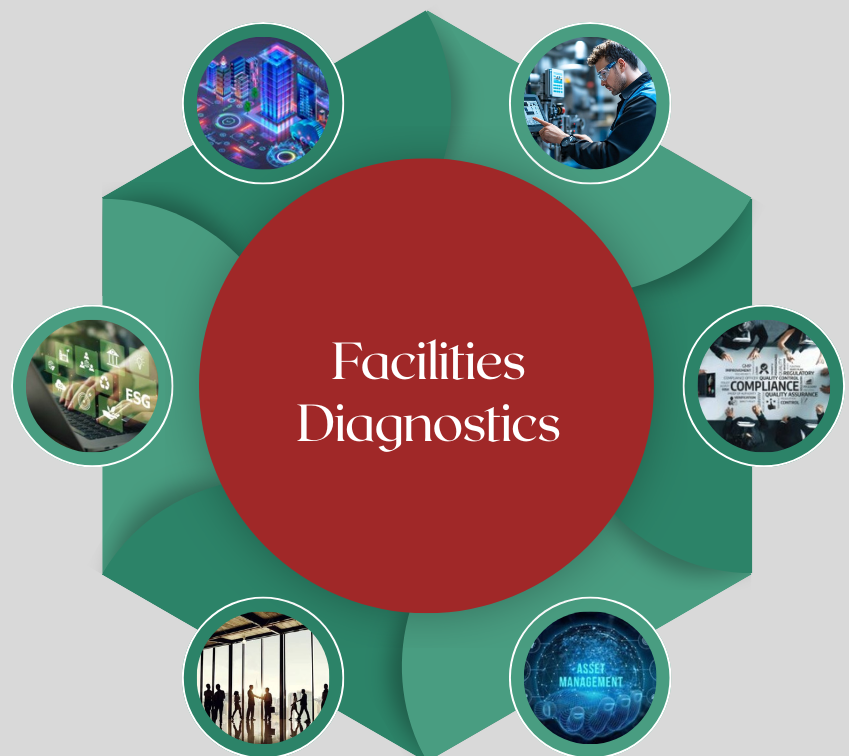
At TriVantage OptiMAS we start by assessing your existing maintenance and related FM processes using our Facilities Diagnostic. From this we can establish which areas need overhauling, what challenges need to be addressed and what opportunities could be realised.
This Facilities Diagnostics process follows a holistic path through each element inherent in Facilities and typically includes:
- Stakeholder engagement to understand linkages between your teams, consumers, contractors, subcontractors, etc.
- A review exercise to consider data, reporting, compliance, financial and communication aspects across Maintenance, Compliance, Assets, Consumers, Sustainability and Systems.
- Process mapping to identify inefficiencies, bottlenecks, workarounds and disconnected processes.
- The creation of a Prioritised Action Plan focused on critical areas first, whilst building a long-term Facilities Strategy.
It’s unlikely any business wants to receive a long list of areas to address and be left to get on with it! That is absolutely not how TriVantage works! The outputs from the Diagnostic are only the first part of the Current State phase.
Our next step is to work with you in reviewing the key focus areas and to determine what the desired Future State might look like. This might be focused on improving reporting, providing visibility across the estate, supporting expansion, improving efficiency, reducing costs, addressing compliance issues, amongst other potential drivers.
Whatever the activities required to deliver your desired future state we will work on them with you and where new technology is required we can define the specification, focused on new ways of working, to ensure you select the best system for your business.
Achieving the desired Future State might require the completion of a range of activities. Typically these could include:
- Introducing or modifying preventative, predictive and/or proactive maintenance programmes.
- Creating a robust Asset Management Strategy, including focused upgrade programs.
- Clearly defining responsibilities across multi-use, multi-ownership, multi-located estates.
- The identification and selection of appropriate software(s) and operating technologies to drive cost reduction, efficiency improvement, management information and compliance.
Finally, we will work with you to plan the entire transition process to ensure you have clarity of what needs to happen by when, who will be involved and what will be required.
At the end of the day, you have a business to run whilst all this change is happening and we need to ensure you can keep the lights on!
Transition
No matter the scale of your transition project, it’s going to impact your employees, consumers, delivery partners and other stakeholders.
With many years’ experience of taking businesses like yourselves through these types of projects we can work with you to minimise the disruption whilst maximising the benefits received.
In particular, where there is a systems component, those unfamiliar with software deployment may see it as a mechanical process – a simple, straightforward series of tasks that can happen in the background. Just something the vendor will do – right? Definitely wrong!
As we said above, you have a business to run whilst all this change is happening and we need to ensure you can keep the lights on!
No matter the scope or scale of the changes, the Transition phase will require a series of approaches that we will align to match your specific requirements, including:
- Change Management – ensuring that you bring your team through the transition successfully
- Data Management – recognising the impact of data in the successful running of new processes, ways of working and systems, as well as reporting
- Quality Control – validating that the solutions are aligned with what was intended, remain relevant to requirements and focused on delivering the expected improvements
- Integration – maintaining the visibility and effectivity of every touchpoint in the process flows, together with all stakeholders and 3rd party providers or contractors
- Reporting & Analysis – monitoring the change process and data management to ensure that required reporting and analysis can be provided as a result of this change programme
- Project Management – keeping all of the above activities to plan!
Future State
The one thing we can take as certain, is that things in the FM world will change! Having gone through an extensive change process, it’s vital to carefully monitor the business and adapt accordingly. We can work with you to carry out a series of activities, like those mentioned below, to ensure that you remain agile and effective in what is likely to continue to be a challenging world:
- Health Checks
- Compliance Validation
- Gap Analysis
- Continuous Improvement.
Future State requirements will depend on each client’s specific requirements, but could include:
- Health Checks – to ensure that the Future State design remains fit for purpose as it becomes the Current State and that it continues to be aligned with operational and strategic requirements.
- Compliance Validation – to ensure that your systems, processes and data continue to deliver the activities, resulting information and reporting necessary to adhere to current and future compliance requirements.
- Gap Analysis – where we discover gaps between current ways of working and requirements, we will work with you and relevant third-parties to effectively and efficiently address these issues.
- Deferred Elements – during the Transition phase, decisions may have been taken to defer certain changes, system functionality, business locations or formats, integration requirements or similar, to narrow the focus of the initial project. But all these elements are likely to still be required, with the overall success of the project likely diminished without them. Our job here is to keep your eye on the final goal, not just the first pit stop!
- Continuous Improvement – Even when everything in the plan has been implemented and checked, there is still a need to carry out periodic reviews. This is especially true if, or more likely when, your strategic direction changes. We can remain your long-term partner, walking with you every step of the way!
Get in Touch.
We’d love to hear from you. For a friendly chat or to request a consultation, please complete the form, and we’ll get back to you as soon as possible