Where Do You Start?
Let’s start from the premise that you’re getting data on the various buildings within your estate. Maybe even dashboards like this image. These are often presented as the solution to all your facilities issues by vendors who’ve sold you the latest software.
But what if they’re not?
What if each measure is telling a different story?
What if the messages make no sense?
What if they don’t align with what your team are saying?
Where do you start?

The Challenge
Let’s continue with the premise above, but if this isn’t the case then we can help! Typically, you will be looking at metrics across a range of areas, including the following:
- Asset management
- Maintenance history
- Work order activity
- Key financials
- Consumption tracking
- Contractor performance
- Compliance status
However, whilst collecting extensive data through building systems, IoT sensors, and operational processes, do you struggle to utilise it effectively for strategic planning beyond basic reporting requirements.
This disconnect between data availability and actionable insights represents one of the biggest missed opportunities in modern facilities management. This adversely affects the ability of a facility manager to manage resources efficiently and maintain high operational standards. In turn directly impacting an organisation’s core business performance.
We’ve already covered data quality in another Insight, so this time we’re focusing more on the risks associated with targeting activities in one area of your built environment, without considering its potential impact on other areas. In other words, seeing a building as a series of silos rather than an integrated ecosystem.
The FM Ecosystem
ISO defines Facilities Management as an “organisational function which integrates people, place and process within the built environment with the purpose of improving the quality of life of people and the productivity of the core business.
Workplaces represent a large proportion of any operation’s costs, so when organisations bring people together in them there must be a value to doing that. There is, and it comes about through making connections and engendering joint purpose and direction. Workplace professionals interconnect between specialisms to optimise business performance; they empower work wherever it takes place and to make workplaces productive. (Source IWFM.)
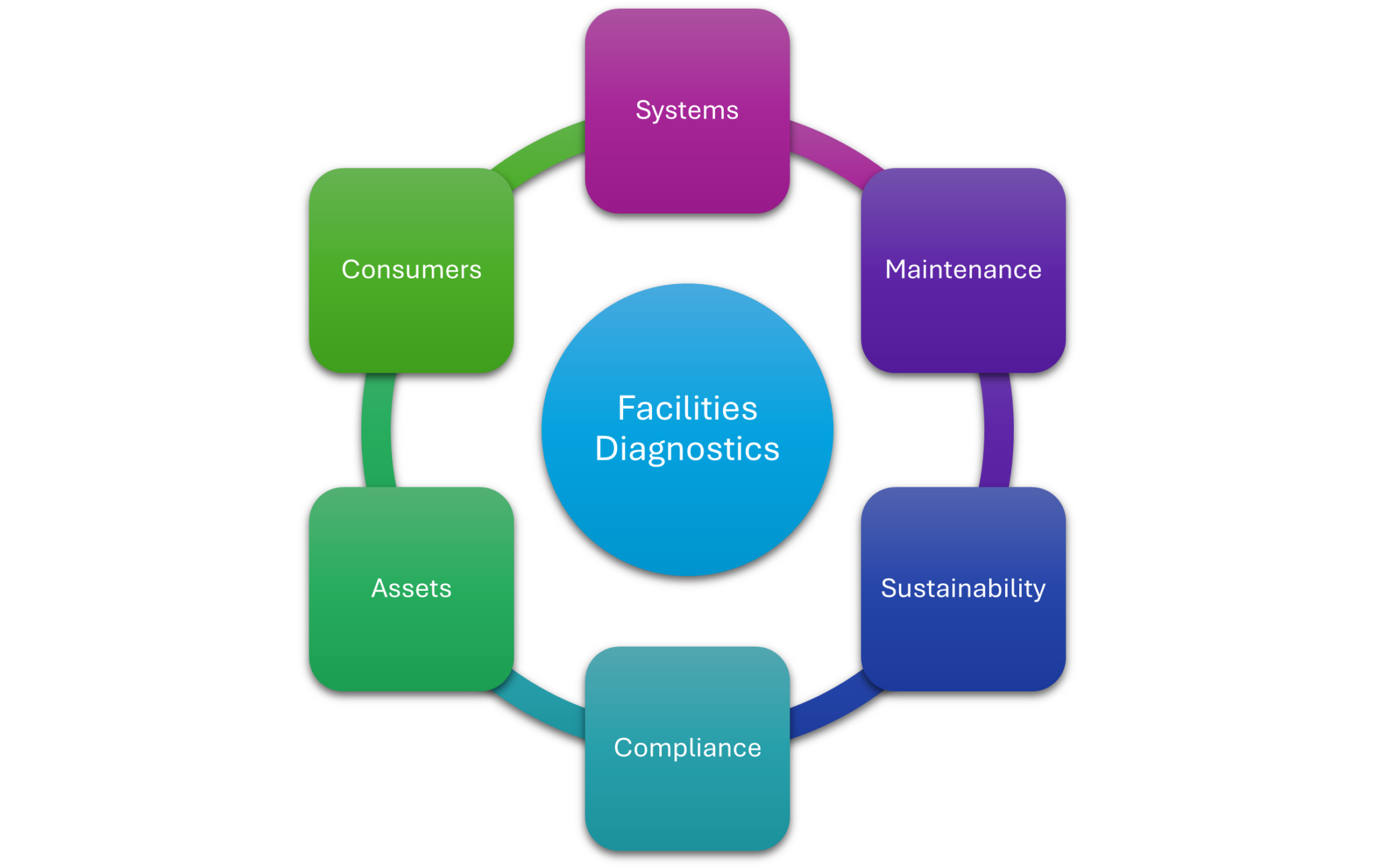
Recognising the inherent dependencies between people, place and process demonstrates why a holistic approach to problem solving is better than looking at things in isolation.
Introducing Facilities Diagnostics
Once you start to think about the built environment as an ecosystem with multiple dependencies, it soon becomes clear that a more typical health-check approach simply isn’t appropriate.
In facilities management, a health-check provides a broad overview of building compliance and operational status, akin to a routine physical. A diagnostic, however, is an investigative procedure designed to pinpoint the exact root cause of an anomaly.
Taking a diagnostics approach is more effective because it transitions the facility from reactive to proactive care.
This is why we’ve recently launched our own Facilities Diagnostics programme, which looks at each of the key elements first, to ensure that any resultant activities consider dependencies within the facilities ecosystem.
But remember this is only an introduction, so if you don’t have someone on the team with experience of Facility Diagnostics, you need to consider sourcing experts to walk beside you. This is what TriVantage OptiMAS does!